




Introduction: The Future of Digital Marketing
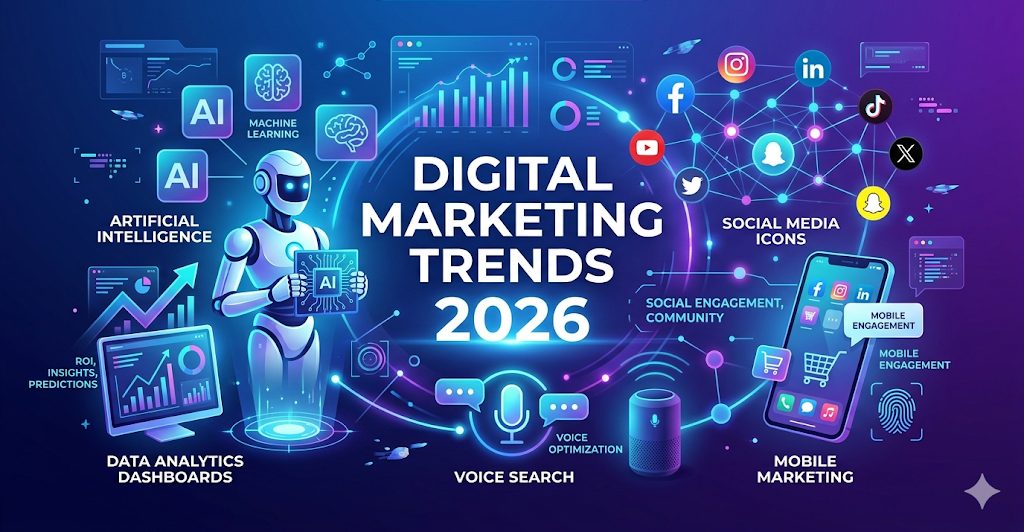
Digital marketing continues to evolve at a rapid pace as technology, consumer behavior, and digital platforms transform the way businesses interact with their audiences. By 2026, the marketing landscape will look significantly different from today. Companies that want to remain competitive must adapt to emerging trends and innovative strategies.
From artificial intelligence and hyper-personalization to voice search and immersive technologies, the next phase of digital marketing will be more data-driven, customer-focused, and automated than ever before. Understanding these changes will help marketers build stronger strategies, deliver better customer experiences, and stay ahead of competitors.
In this article, we explore 10 digital marketing trends and predictions that will shape 2026 and influence how brands communicate with their audiences in the coming years.
1. AI-Powered Marketing Will Dominate
Artificial intelligence is rapidly transforming digital marketing. In 2026, AI will play a central role in marketing strategies across industries.
AI-powered tools will enable marketers to analyze massive datasets, identify patterns in consumer behavior, and automate complex processes. Businesses will rely on AI for content creation, campaign optimization, customer segmentation, and predictive analysis.
AI-driven marketing platforms can generate insights that allow marketers to understand customer preferences and deliver targeted campaigns with higher efficiency. This level of automation will help companies reduce costs while improving marketing performance.
2. Hyper-Personalization in Marketing
Personalization has been a growing trend in recent years, but by 2026 it will reach a new level known as hyper-personalization.
Hyper-personalization uses real-time data, artificial intelligence, and behavioral insights to deliver highly relevant content and product recommendations to individual users. Instead of generic marketing messages, consumers will receive tailored experiences based on their preferences, browsing history, and purchasing behavior.
Brands that invest in personalization technologies will build stronger relationships with their customers and increase conversion rates significantly.
3. Voice Search Optimization
Voice search is becoming increasingly popular with the rise of smart speakers and voice assistants like Google Assistant, Alexa, and Siri.
By 2026, voice search is expected to account for a significant portion of online searches. This shift will require marketers to optimize their content for conversational queries and natural language.
Businesses will need to focus on long-tail keywords, question-based search phrases, and structured content that answers user queries quickly. Voice search optimization will become an essential component of SEO strategies.
4. Video Marketing Will Continue to Grow
Video content is already one of the most powerful forms of digital marketing, and its importance will continue to grow in 2026.
Platforms like YouTube, TikTok, Instagram Reels, and other short-form video platforms are reshaping how consumers consume content. Short, engaging, and informative videos will dominate digital marketing strategies.
Live streaming will also play a key role in connecting brands with audiences in real time. Businesses that leverage video marketing effectively will capture attention and build stronger engagement with their customers.
5. Influencer Marketing Evolution
Influencer marketing has become a major component of digital marketing strategies. However, the influencer landscape is changing.
In 2026, brands will increasingly collaborate with micro-influencers and nano-influencers rather than celebrities or mega influencers. These smaller influencers often have highly engaged audiences and stronger relationships with their followers.
Brands will prioritize authenticity, trust, and niche communities over massive follower counts. As a result, influencer marketing campaigns will become more targeted and effective.
6. Cookieless Marketing and Data Privacy
Data privacy regulations and browser changes are pushing the marketing industry toward a cookieless future.
Third-party cookies are gradually being phased out, forcing marketers to find new ways to collect and use customer data responsibly. In 2026, businesses will rely heavily on first-party data gathered directly from customers through website interactions, subscriptions, and loyalty programs.
Transparent data practices and strong privacy policies will be essential for building trust with consumers.
7. Conversational Marketing
Consumers expect quick and convenient communication with brands. Conversational marketing will become even more important in 2026.
Chatbots, AI-powered messaging systems, and real-time customer support tools will allow businesses to interact with customers instantly. These tools will help brands answer questions, recommend products, and guide customers through the buying process.
Conversational marketing improves customer experience while increasing lead generation and sales.
8. Omnichannel Customer Experiences
Consumers today interact with brands through multiple channels including websites, social media, email, mobile apps, and online marketplaces.
By 2026, successful marketing strategies will focus on delivering seamless omnichannel experiences. This means ensuring consistent messaging and smooth transitions across all digital platforms.
For example, a customer may discover a product on Instagram, research it on a website, and complete the purchase through a mobile app. Marketers must ensure a unified experience throughout this journey.
9. AR and Interactive Marketing
Augmented reality (AR) and interactive experiences are transforming how consumers engage with brands.
AR technology allows customers to visualize products in real-world environments before making a purchase. For example, furniture retailers allow customers to see how a sofa would look in their living room using AR apps.
Interactive marketing techniques such as quizzes, polls, and gamified experiences will also become more common. These strategies encourage deeper engagement and create memorable brand experiences.
10. Predictive Analytics and Data-Driven Marketing
Data-driven marketing will become even more sophisticated in 2026. Predictive analytics will enable businesses to forecast customer behavior and identify future trends.
Using advanced analytics tools, marketers can predict which products customers are likely to buy, when they will make purchases, and what type of content they prefer.
These insights will help companies create smarter marketing campaigns, optimize budgets, and improve overall performance.
Conclusion: Preparing for the Future of Marketing
The digital marketing landscape in 2026 will be defined by innovation, technology, and customer-centric strategies. Artificial intelligence, hyper-personalization, voice search, and immersive technologies will reshape how businesses connect with their audiences.
Companies that stay informed about emerging trends and adopt new marketing technologies will have a significant competitive advantage.
By focusing on data-driven insights, personalized experiences, and integrated marketing strategies, businesses can build stronger relationships with customers and thrive in the evolving digital marketplace.
The future of digital marketing is dynamic and full of opportunities. Organizations that adapt early will be best positioned for success in 2026 and beyond.
FAQ
The biggest digital marketing trends in 2026 include artificial intelligence in marketing, hyper-personalization, voice search optimization, video marketing, influencer marketing, and predictive analytics.
AI will automate marketing campaigns, improve personalization, analyze customer data, and help marketers create more targeted and effective marketing strategies.
Personalization improves customer experience by delivering relevant content, product recommendations, and marketing messages based on individual user behavior and preferences.